Data security is still the main topic of conversation in boardrooms as businesses quickly embrace AI. Large language models have strong capabilities, but their frequent reliance on external APIs raises issues with data leakage and compliance problems.
Private RAG Architecture becomes crucial in this situation. Businesses can harness AI capabilities without jeopardising critical data by integrating retrieval-augmented generation with safe internal infrastructure. Enterprise data is safeguarded and intelligent, context-aware responses are made possible by a well-designed Secure RAG Architecture.
Fundamentally, Private Retrieval Augmented Generation enables businesses to utilise their own data sources in a secure setting. Businesses are building scalable, compliant AI systems that adhere to contemporary governance norms with the aid of platforms such as AIVeda. Private RAG Architecture is rapidly taking center stage in company AI efforts as demand rises.
What is Private RAG Architecture?
The term “private RAG architecture” describes a safe retrieval-augmented generation implementation in which the model and data function in a controlled setting. This method guarantees that sensitive data never leaves enterprise borders, in contrast to conventional systems that depend on public APIs.
Data is first indexed into a vector database in Private Retrieval Augmented Generation. Upon receiving a user inquiry, pertinent documents are obtained and sent to the model so that it can produce precise answers. The entire process is carried out in a safe environment.
This idea is expanded upon in a contemporary Enterprise RAG Architecture by incorporating integration, governance, and scalability features. Models can be installed on-prem or in private clouds, giving organisations total control over data consumption and access.
Businesses can achieve both performance and privacy by implementing two essential needs in the current AI environment.
Why Enterprises Need Secure RAG Architecture
Businesses operate in settings where regulatory compliance and data sensitivity cannot be compromised. Risks associated with using public AI systems include data leakage, illegal access, and regulatory infractions.
By guaranteeing that all data processing happens in secure environments, a strong Secure RAG Architecture allays these worries. In industries like finance, healthcare, and SaaS, where even little breaches can have serious repercussions, this is particularly crucial.
Better governance is also possible with an efficient Enterprise RAG Architecture. Access controls, usage monitoring, and system-wide policy enforcement are all possible for organisations. Generic, public AI solutions cannot provide this degree of control.
In the end, implementing Private RAG Architecture is about developing trust as much as security. Businesses may confidently incorporate AI into crucial workflows with a well-executed Secure RAG.
Main Elements of a Private RAG Architecture
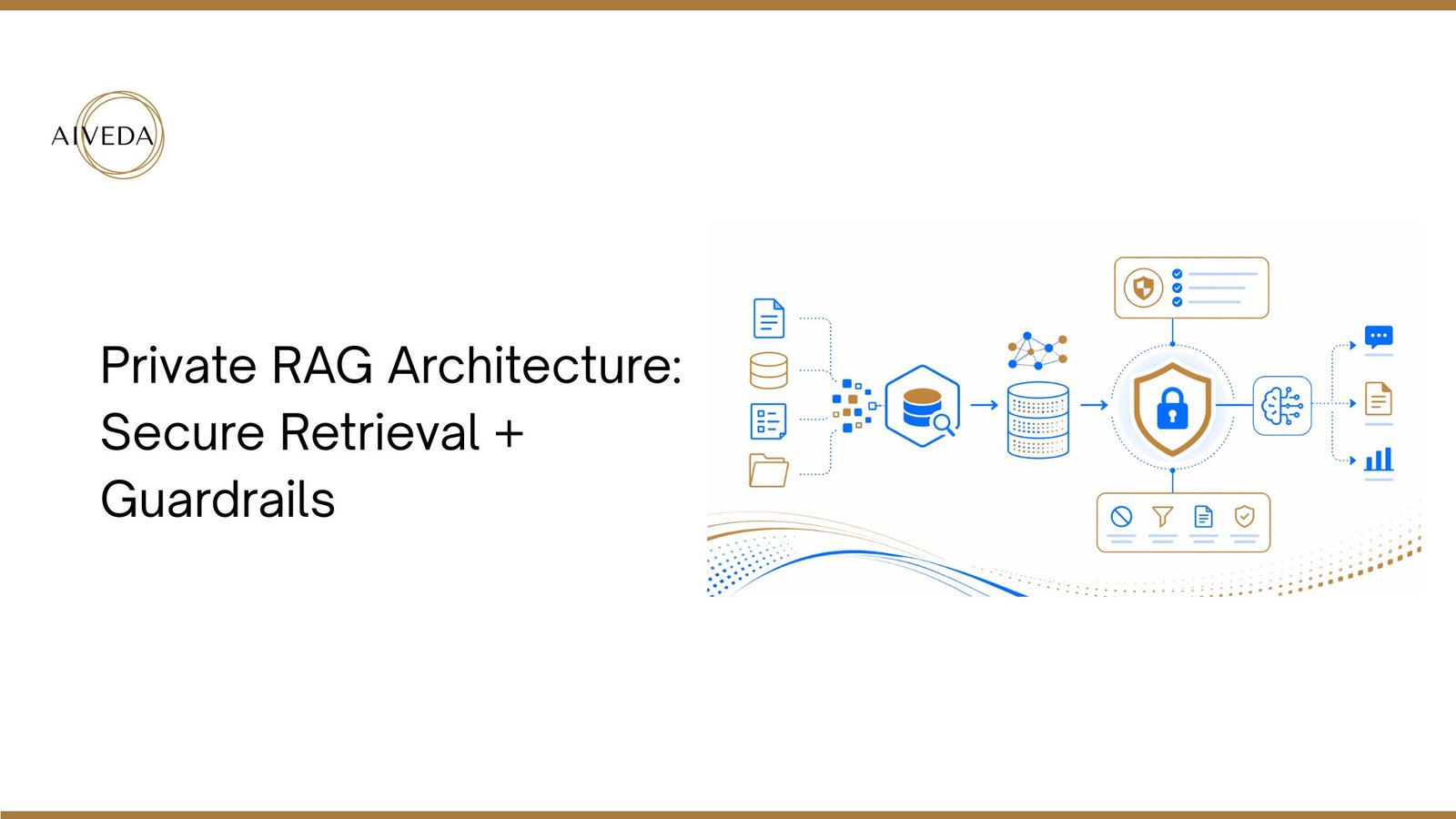
Several interconnected layers, each intended to guarantee performance, security, and dependability, comprise the foundation of an effective Private RAG Architecture.
1. Data Layer
Structured databases, unstructured documents, and internal knowledge bases are all included in this tier. Sensitive information is protected by stringent access restrictions and encryption techniques.
2. Retrieval Layer
To locate pertinent data, the retrieval system employs vector search and embeddings. This layer is essential to providing the model with accurate context in Private Retrieval Augmented Generation.
3. Generation Layer
The language model can be implemented on-prem or in a private cloud, making up the generating layer. This guarantees the security and compliance of the entire Private RAG Architecture.
4. Guardrails Layer
Guardrails lessen hallucinations, filter outputs, and enforce policies. They are necessary to keep a Secure RAG Architecture intact.
Why Guardrails in Private RAG Architecture Matter
To guarantee accuracy, safety, and compliance, AI outputs must include guardrails. Even the most sophisticated algorithms could yield damaging or deceptive results without them.
Guardrails function at several levels in an Enterprise RAG Architecture. While output moderation filters improper or sensitive responses, input validation makes sure that only pertinent queries are executed. By limiting access to data, role-based access control improves security even more.
Guardrails are another tool in a well-designed Secure RAG Architecture to reduce hallucinations and ensure that answers are based on validated data sources.
Organisations may turn Private RAG Architecture into a reliable AI solution that complies with regulations and business objectives by incorporating strong guardrails.
Benefits of Private RAG Architecture for Enterprises
It has a number of benefits for businesses wishing to scale AI safely.
Data Security and Privacy (Data Sovereignty): A private RAG system often uses a private cloud or on-premises infrastructure and preserves data security, such as internal documentation, codebases, and client data inside the company’s network. This guarantees that private data is not utilised to train public models and stops data leaks.
Improved Accuracy and Reduced Hallucinations: Private RAG reduces hallucinations and generates reliable responses by basing AI responses on validated, current internal documents rather than static, public training data.
Regulatory Compliance and Auditability: Private RAG enables businesses to implement role-based access controls (RBAC) to guarantee that workers only access information they can view. Additionally, it offers thorough logging and audit trails, making it possible to confirm how AI came to a particular conclusion.
Cost-effective Scaling and Performance: Private RAG offers 10 times cheaper operating costs than public AI APIs at big volumes by dynamically updating its knowledge base in place of expensive full model retraining. Additionally, it eliminates delay problems related to calls made via public networks.
Real-Time Knowledge Access: As new documents are created, private RAG systems can index them, making them instantly accessible for analysis. This guarantees that AI solutions take into account the most recent company data. Goldfish Effect Protection: Private RAG systems use “ephemeral” data access, which assures that data is not held by the system and lowers exposure risks. This involves briefly accessing sensitive data to generate an answer and then deleting it.
Private RAG Architecture vs Traditional RAG
Understanding the difference between architectures helps enterprises make informed decisions.
| Feature | Private RAG Architecture | Traditional RAG |
| Data Security | High (internal control) | Low to Medium |
| Compliances | Enterprise- ready | Limited |
| Deployment | On-prem/ private cloud | Public APIs |
| Customisation | High | Limited |
| Guardrails | Advanced | Basic |
As you can see in the table above, in comparison, a Secure RAG Architecture provides the control and reliability that enterprises require. Therefore, making Private RAG Architecture the preferred choice.
How to Build a Private RAG Architecture
Step 1: Identify Data Sources
Determine internal data, including knowledge bases, databases, and documents.
Step 2: Select Safe Infrastructure
Install systems in a private cloud or on-prem to facilitate a Secure RAG Architecture.
Step 3: Put the Retrieval System in Place
To enable Private Retrieval Augmented Generation, use vector databases and embeddings.
Step 4: Use the Model
Select a fine-tuned or private model to incorporate into your Enterprise RAG Architecture.
Step 5: Install Guardrails
To guarantee safe outputs, put validation, moderation, and monitoring into practice.
Step 6: Continue to Optimise
Utilise data and feedback loops to improve performance.
Organisations can create scalable Enterprise RAG Architecture more quickly and effectively because of solutions like AIVeda, which streamline the process.
Challenges in Implementing Private RAG Architecture
Businesses must overcome a number of technological and operational obstacles while implementing:
- Departmental data silos make it challenging to combine information for efficient Private Retrieval Augmented Generation.
- Implementation is technically challenging due to complex infrastructure needs, such as on-prem deployment or private cloud deployments.
- Adoption may be slowed by high initial implementation costs for computation, storage, and model configuration.
- Continuous monitoring is necessary to maintain stringent data privacy and regulatory compliance.
- Reliability depends on the design and adjustment of guardrails to stop hallucinations and dangerous outputs.
- It can be difficult to integrate databases, CRMs, and legacy systems into a single process.
- The system must be continuously optimised, updated, and monitored in order to remain precise and effective.
Implementation is frequently delayed by a lack of internal AI competence, which forces businesses to hire platforms like AIVeda.
Future of Private RAG Architecture in Enterprise AI
The development of enterprise AI is directly related to the future. Businesses will use Secure RAG Architecture more frequently to ensure compliance as rules become more stringent.
Automation, adaptive guardrails, and sophisticated monitoring systems are all integrated into a contemporary enterprise RAG architecture. This will enable businesses to scale AI while preserving transparency and control.
Private RAG Architecture will be essential to allowing safe, intelligent, and dependable AI systems across industries as innovation progresses.
Conclusion
By fusing secure retrieval with strong safeguards, Private RAG Architecture is revolutionising how businesses approach AI. It covers important issues with reliability, compliance, and data privacy.
Organisations can fully utilise AI without sacrificing control by implementing a Secure RAG Architecture. Businesses may provide more precise and context-aware solutions with the further advantages of Private Retrieval Augmented Generation.
This shift is being spearheaded by platforms like AIVeda, which assist businesses in developing scalable and legal AI systems. It will continue to be a key component of organisational innovation as the need for secure AI increases.
FAQs
What is Private RAG Architecture?
A secure AI architecture called Private RAG Architecture combines generation and retrieval in regulated settings to safeguard business data.
What distinguishes Secure RAG Architecture from conventional RAG?
Unlike previous RAG systems that depend on public APIs, Secure RAG Architecture guarantees data protection, compliance, and controlled deployment.
What is the significance of Private Retrieval Augmented Generation?
It makes it possible for businesses to use internal data safely, increasing accuracy while upholding stringent data protection regulations.
What are guardrails in the context of Enterprise RAG Architecture?
Guardrails are systems that make sure AI systems respond safely and accurately, enforce policies, and filter outputs.
Is it possible to employ small language models in the Private RAG Architecture?
It is possible to implement small language models for effective, affordable, and safe AI solutions.
About the Author

Avinash Chander
Marketing Head at AIVeda, a master of impactful marketing strategies. Avinash's expertise in digital marketing and brand positioning ensures AIVeda's innovative AI solutions reach the right audience, driving engagement and business growth.