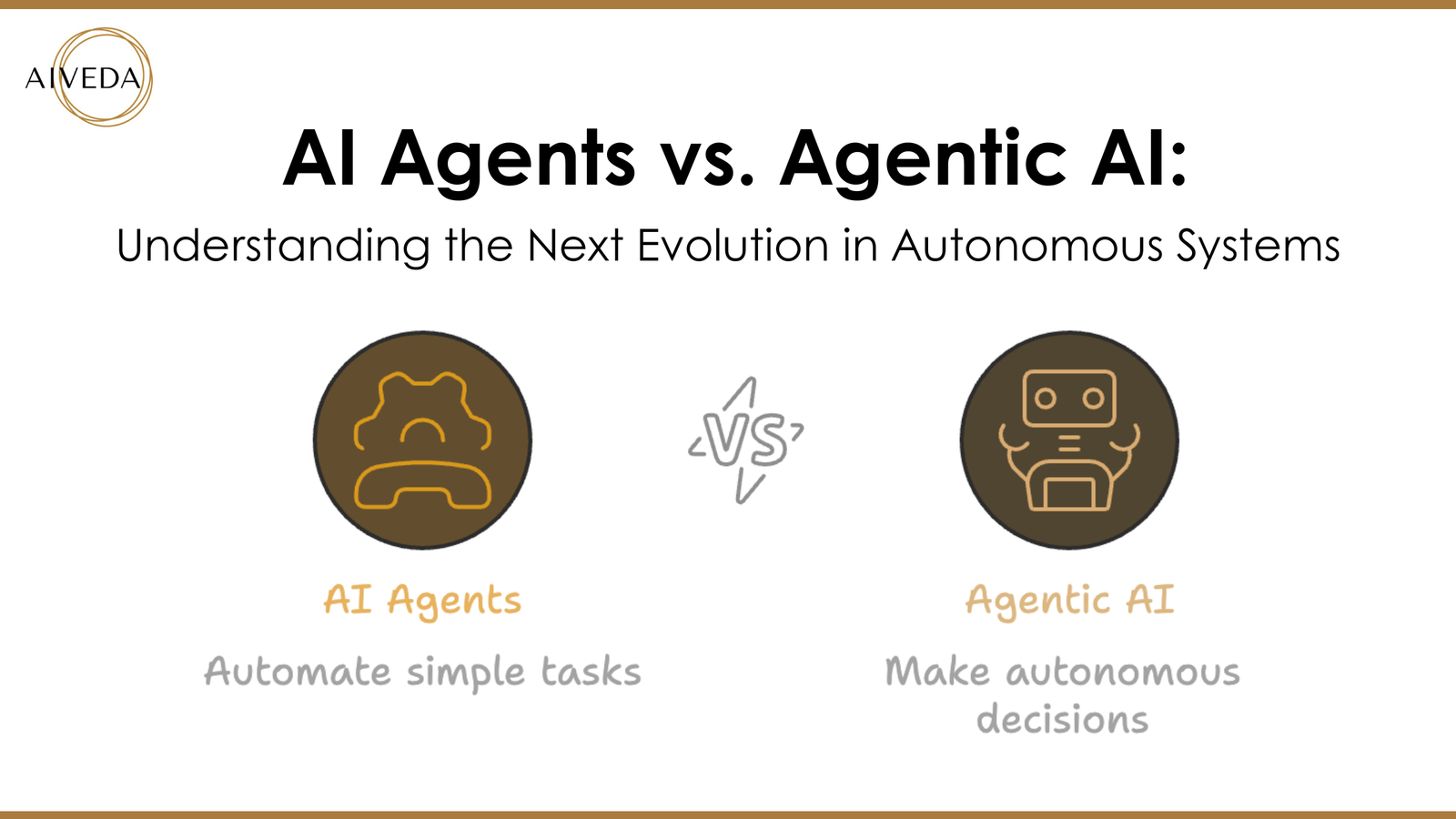
Artificial Intelligence (AI) has evolved significantly over the past few decades, expanding its capabilities and applications across industries. Within this vast field, two terms that often surface are AI Agents and Agentic AI. While they might appear similar at first glance, each represents a distinct approach to how AI interacts with and interprets the world. Understanding these differences is essential for organizations looking to leverage AI effectively, researchers exploring new frontiers in autonomous systems, and decision-makers aiming to invest in the right technology.
In this comprehensive technical blog, we will dive into the nuances between AI Agents and Agentic AI. We will explore their foundations, development processes, real-world applications, as well as how they differ in terms of autonomy, decision-making, and ethical considerations. By the end, you should have a clearer picture of which AI approach—or combination thereof—could best serve your particular needs and how the future might evolve in this rapidly advancing space.
Also Read: How To Build An AI Agent
1. Defining AI Agents and Agentic AI
To clarify the discussion, it’s crucial to begin by outlining what each term means.
1.1 AI Agents
AI agents are software entities designed to perform tasks autonomously based on inputs and goals defined by humans. They are often built using components such as machine learning (ML), natural language processing (NLP), and reinforcement learning, depending on the complexity of their tasks.
- Autonomy: AI agents typically have a specific, often narrow scope, such as a chatbot that handles customer queries or a system that controls a robotic arm on an assembly line.
- Learning: They may learn from data or feedback loops, improving their performance over time. However, their scope is usually confined to the tasks they were explicitly designed for.
- Decision-making: These agents make decisions based on algorithms and rules. While they might adapt or learn new patterns, they generally remain bounded by the objectives set by developers or operators.
1.2 Agentic AI
Agentic AI represents AI systems with a higher degree of autonomy and self-directed behavior than traditional AI agents. While not necessarily “sentient,” these systems exhibit qualities that could be described as agentic, including:
- Goal Generation: Instead of merely following human-defined goals, agentic AI systems can set their own sub-goals to achieve overarching objectives.
- Self-Modification: They can refine or even rewrite their internal algorithms to handle new or evolving challenges.
- Broader Adaptability: Unlike many AI agents that operate within a strict environment, agentic AI might adapt to unanticipated conditions, pivoting strategies without extensive reprogramming.
A key hallmark of agentic AI is that it pushes the boundaries of what we traditionally consider “AI autonomy,” inching closer to forms of generalized intelligence, although not necessarily achieving “human-like” cognition.
2. The Evolution of Autonomy in AI Systems
The differences between AI Agents and Agentic AI become clearer when we consider how AI autonomy has evolved:
- Rule-Based Automation (Early AI): Systems followed strict if-then-else logic with no real learning capabilities.
- Machine Learning–Infused Agents: Systems learned from data, enabling them to adapt but still remain tethered to human-defined tasks.
- Agentic AI and Self-Directed Goals: Systems can hypothesize new goals, reconfigure their “mental models,” and operate with minimal human supervision in dynamic environments.
This progression indicates how AI Agents typically align with the second tier—machine learning–infused solutions—whereas Agentic AI tries to operate in the third tier, taking autonomy to new levels.
Also read: What Is Agentic AI, and Why Does It Matter for Your Business?
3. Core Components and Architectures
While both AI Agents and Agentic AI share certain underlying technologies like machine learning frameworks, each requires specific architectural approaches to achieve their respective levels of autonomy.
3.1 Architectures for AI Agents
- Goal-Oriented Design: Agents are built around specific tasks, like “answer customer queries” or “navigate a warehouse.”
- Reactive or Proactive: Some AI agents react to stimuli (event-based), while others can proactively seek data or perform tasks when certain conditions are met.
- Reinforcement Learning: Many agents use RL to learn optimal strategies in environments, typically bounded by specific reward functions.
3.2 Architectures for Agentic AI
- Recursive Self-Improvement: Some agentic systems explore ways to refine their models iteratively.
- Meta-Learning: This approach allows systems to learn how to learn, adapting algorithms on the fly to handle unseen tasks.
- Multi-Agent Systems: In advanced scenarios, multiple agentic AIs communicate, share knowledge, and coordinate, forming a collaborative intelligence network.
4. Key Differences: Autonomy, Adaptability, and Goals
- Autonomy:
- AI Agents: Operate autonomously but generally remain bound by predefined goals and constraints.
- Agentic AI: Exhibit more robust autonomy, including the potential to devise sub-goals aligned with (or in some cases, tangential to) initial objectives.
- Adaptability:
- AI Agents: Learn from specific datasets or feedback but rarely re-define their learning frameworks spontaneously.
- Agentic AI: Continually reinterprets environment and data, adjusting its frameworks or strategies with minimal human intervention.
- Goal Orientation:
- AI Agents: Follow explicit goals set by developers or system integrators.
- Agentic AI: Possesses the capacity for self-directed goal generation, forming sub-goals or new lines of inquiry to accomplish broader tasks.
5. Real-World Applications
5.1 AI Agents in Action
- Customer Service Chatbots: Traditional chatbots or virtual assistants capable of answering frequently asked questions.
- Process Automation: RPA (Robotic Process Automation) tasks in finance or HR where the agent handles structured data.
- Predictive Maintenance: Systems that analyze sensor data in manufacturing, scheduling repairs without human oversight.
5.2 Agentic AI in Action
- Advanced Robotics: Robots that can navigate complex environments (like disaster zones) with minimal guidance.
- Adaptive Cybersecurity: Systems that dynamically adjust defenses to novel cyber threats, beyond simple pattern matching.
- Exploratory Research Systems: AI programs that propose hypotheses in fields like drug discovery or climate modeling, shifting strategies as new data arises.
6. Ethical and Security Implications
With greater autonomy comes heightened ethical and security considerations:
- Decision Accountability: AI Agents typically follow a transparent chain of command. In Agentic AI, accountability can become murky if the system sets its own sub-goals.
- Bias and Fairness: Both AI Agents and Agentic AI can inadvertently reflect biases. Comprehensive data governance and model validation are essential.
- Security Risks: Highly autonomous AI could be tricked or manipulated if adversaries manage to tamper with data or reward functions. A well-defined safety protocol is crucial.
7. Development Challenges and Best Practices
- Technical Complexity
- AI Agents: Complexity revolves around algorithm selection, model training, and integration with existing systems.
- Agentic AI: Complexity escalates as systems self-modify and handle tasks that exceed initial design.
- Interdisciplinary Collaboration
- Collaboration among data scientists, software engineers, domain experts, and ethicists helps guide project success.
- For agentic systems, philosophical and ethical experts may also be needed to define boundaries.
- Iterative Development
- Prototyping is vital for both. Start small, measure outcomes, and refine.
- Use agile methodologies for continuous improvement and adaptability.
8. Pros and Cons at a Glance
| Factor | AI Agents | Agentic AI |
| Scope | Narrow to moderately broad tasks | Potentially broad and ever-expanding tasks |
| Adaptability | Learns within predefined constraints | Capable of self-directed goal evolution, higher adaptability |
| Implementation Complexity | Usually simpler due to well-defined tasks | More complex requiring advanced architecture and multi-level governance |
| Risk & Ethical Concerns | Lower risk, clearer accountability | Higher risk especially if sub-goals diverge from original ethical principles |
| Resource Demands | Moderate, depends on dataset size and performance needs | High, especially when enabling self-improvement and large-scale computations |
9. Which One is Right for Your Organization?
- Startup or SME: If you’re a startup needing automated solutions quickly, AI Agents with a well-defined scope might suffice.
- Enterprise with Complex Demands: Larger organizations with varied tasks and the need for advanced autonomy might explore Agentic AI for real-time data adaptation.
- Hybrid Strategy: Many organizations find synergy by using AI Agents for standard processes while researching or piloting Agentic AI for future-proofing advanced capabilities.
10. The Future: Merging AI Agents and Agentic AI?
We might see a convergence where classical AI agents, each highly specialized, form a multi-agent system with “agentic” capabilities. Imagine a hybrid architecture where certain tasks remain within strict control, while certain modules operate with agentic freedom to explore novel strategies. This approach ensures both stability and innovation.
Moreover, breakthroughs in Neural Architecture Search (NAS), meta-learning, and self-reinforcement could enable more AI systems to become agentic, bridging the gap between conventional AI agents and next-level autonomy.
Conclusion
Both AI Agents and Agentic AI hold transformative potential for diverse industries. AI Agents excel in specialized, well-defined tasks, acting as reliable “workhorses” for standard automation and data-driven decision-making. Agentic AI, on the other hand, pushes the boundaries of autonomy, adaptability, and self-generated goals, paving the way for more advanced and dynamic systems.
Choosing between these approaches depends on your project’s complexity, ethical considerations, and appetite for innovation. As technology evolves, many organizations might explore a hybrid model, unlocking new horizons in AI-driven efficiency and intelligence. Understanding these distinctions is the first step toward adopting the AI strategy best suited to your mission.
About the Author

Avinash Chander
Marketing Head at AIVeda, a master of impactful marketing strategies. Avinash's expertise in digital marketing and brand positioning ensures AIVeda's innovative AI solutions reach the right audience, driving engagement and business growth.